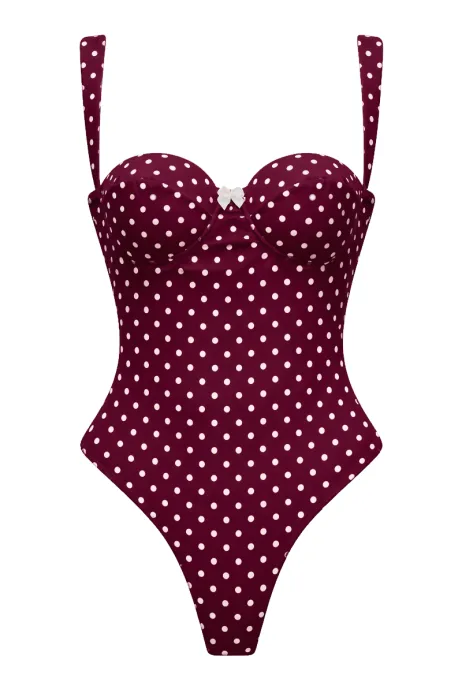
The value of the polka dot bikini Enkris Bikini lies in its entirely handcrafted nature. Every stage in the creation of the polka dot swimsuit is entrusted to tailors who carry out each process by hand. The process follows protocols rooted in Italian tailoring tradition, excluding mass production. This approach guarantees a final product crafted with care in every constructive detail.
The process begins with the manual cutting of the fabric. This step allows the polka dot pattern to be precisely aligned along the seam lines. The visual symmetry of the garment is maintained consistently across the entire surface.
The polka dot swimsuit offers specific structural advantages:
- modulated tension: the operator adjusts the thread tension according to the fabric density to prevent puckering
- edge finishing: every edge is manually trimmed to ensure that the ends lie flat and free of protrusions
- stitch strength: seams are reinforced at the points of highest stress through additional manual passes
Quality control and finishing
The artisan dimension is evident in every single piece. Each polka dot bikini is made from printed microfibre polyester polka dot fabric and subjected to a visual and tactile inspection at every stage of construction. This system ensures the immediate identification of any irregularities in the weave or pattern.
The artisanal care extends to the application of details, ensuring that every element is firmly anchored to the structure of the bikini.
Ergonomics and handmade craftsmanship
The tailors' manual expertise allows the design to be adapted to the real needs of the body. Artisanal construction makes it possible to create ergonomic curves that conform anatomically. The manual shaping process eliminates the rigidity typical of industrially produced garments, optimising comfort during movement.
The craftsmanship of the polka dot bikini Enkris Bikini results in greater longevity. The choice of technical materials, combined with manual construction expertise, creates a resilient product. The absence of defects arising from serial production reduces the risk of structural failures, confirming the soundness of the production methods.


 Italiano
 Français